
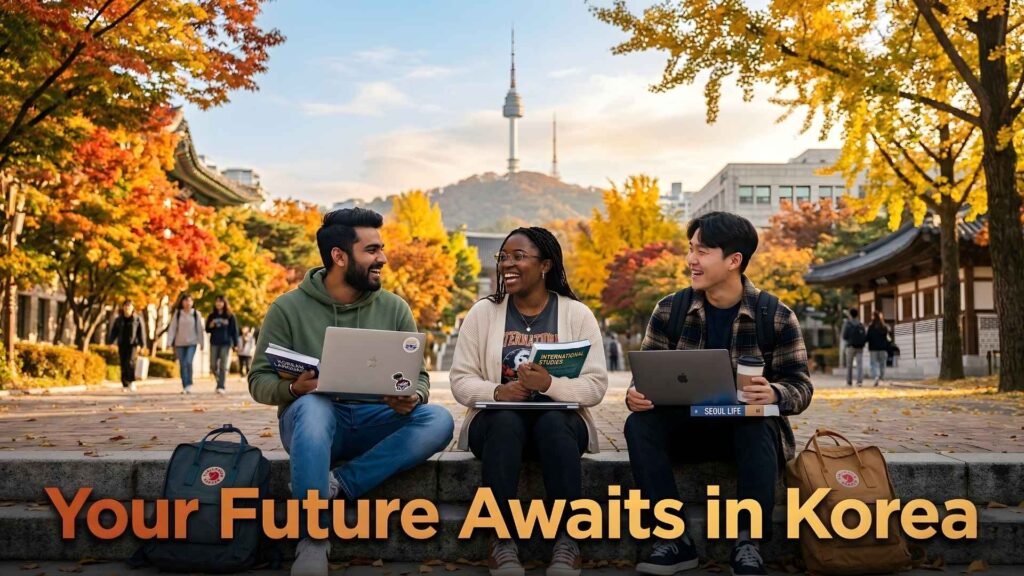
Are you planning to Study in South Korea 2026? Is studying abroad only about the US, UK, Australia, or Canada?
Lately, smart students and parents have started shifting their focus to a destination with incredible value for money—South Korea. Don’t just equate studying in Korea with “K-pop” or “K-dramas” anymore. In 2026, with a wave of major new policies, Korea is becoming a “blue ocean” for international students.
If you’re planning your future path, this article will help you figure out: Is going to South Korea in 2026 actually worth it?
Why Study in South Korea 2026? The Policy Benefits
Many don’t know this, but 2026 is a major year for higher education reform in South Korea. The Ministry of Education has officially announced the “2026 Ministry of Education Development Plan,” centered on three keywords: AI Talent, Regional Balance, and Internationalization. What does this mean? It means opportunities.
1. Visa Policy "Relaxation": The Path to Staying is Unprecedentedly Smooth
The old worry of “you have to leave after graduation” is now a thing of the past:
K-STAR Visa (Fast Track for
STEM)
A fast-track permanent residency route specifically for outstanding STEM talent, previously limited to 5 science & tech institutes, expanded to 32 top universities. With a presidential recommendation, get a long-term F-2 visa and apply for PR after just 3 years.
BK21 Permanent Residency
Fast-Track
For students at the 27 universities selected for Korea's "Brain Korea 21" project, the period to get a permanent residency visa is directly shortened from 6 years to 3 years.
D-10 Job-Seeker Visa Extended
What are graduates most afraid of? Visa expiry before finding a job. Now you have a full 3 years to calmly search for your ideal job, with no upper limit on internship periods.
2. Academic System Innovation: Bachelor's to PhD in Just 5.5 Years?
The Ministry of Education will pilot a new “Integrated Bachelor’s-Master’s-PhD Innovation Track” in 2026. What typically takes over 8 years can now be compressed into 5.5 years. If you connect from high school’s AI elite education, you can complete a doctoral program in just 7.5 years. For students aiming for a research career, this is a significant time advantage.
3. Exchange Rate Window + Generous Scholarships
Due to recent exchange rate fluctuations, 100 RMB now exchanges for approximately 21,000 KRW. Compared to five years ago, tuition and living costs are generally 15% cheaper.
Looking at specific tuition fees (based on the 2026 academic year):
- Public Universities: Approx. 15,000 – 30,000 RMB per semester
- Private Universities: Approx. 30,000 – 60,000 RMB per semester
But the real highlight is scholarships. Korean universities offer extensive scholarship coverage:
- Hanyang University (Engineering): New students with TOPIK Level 6 can get full tuition exemption, TOPIK Level 5 gets a 50% reduction.
- Sungkyunkwan Univ., Korea Univ., etc.: Offer 30%-100% tuition reductions based on academic performance.
- Global Korea Scholarship (GKS): The most prestigious government scholarship covers full tuition + round-trip airfare + monthly living stipend + one year of language training. Isn't that essentially free study abroad?

What Major to Choose? Don’t Just Focus on K-POP
Korea’s strengths in specific academic fields are much more “hardcore” than you might think.
| Field of Study | Recommended Universities | Career Paths |
|---|---|---|
| Artificial Intelligence / Data Science | KAIST, Seoul National Univ., Korea Univ. | Korean Tech Companies, Research Institutes |
| Semiconductors / Electronic Engineering | Hanyang Univ., Sungkyunkwan Univ. | Samsung, SK Hynix, LG |
| Biotechnology / New Materials | POSTECH, UNIST | Research Institutes, Biopharmaceutical Companies |
| International Business / Economics | Yonsei Univ., Korea Univ. | Multinational Corporations, Financial Institutions |
| Design / Arts & Media | Hongik Univ., Chung-Ang Univ. | Entertainment Agencies, Advertising Firms |
Data Snapshot: In the 2026 Times Higher Education World University Rankings, four South Korean universities ranked within the global top 100:
- Seoul National University: Ranked 58th globally (#1 in Korea)
- KAIST: Ranked 70th globally
- Yonsei University: Ranked 86th globally
- Sungkyunkwan University: Ranked 87th globally
Additionally, POSTECH, Korea University, and UNIST are all ranked within the global top 250.
Is Language a Barrier? Not Necessarily.
Many are put off by the thought of learning Korean, but there’s more than one path:
- English-Taught Programs: Korea's top universities offer a wide range of full English-taught programs through their GSIS (Graduate School of International Studies) and many STEM departments. You only need an IELTS score of 5.5-6.5 or TOEFL 80+.
- Language First, Degree Later: You can apply for a one-year Korean language course first. Once you pass TOPIK Level 3, you can enter your undergraduate or graduate program.
- Bilingual Instruction Pilot: Some universities are piloting bilingual programs starting in 2026, lowering the entry barrier.
Plus, the TOPIK test is moving towards digitalization, potentially allowing for home-based testing and AI grading in the future, making it much more convenient.
Real Costs: Can a Typical Family Afford It?
Let’s estimate the annual cost of studying in South Korea in 2026:
Tuition Fees:
- Language Programs: Approx. 10,000 RMB/semester in Seoul, totaling 40,000-60,000 RMB/year.
- Undergraduate: Public universities approx. 20,000 RMB/year, private universities approx. 38,000-45,000 RMB/year.
- Graduate: Typically 50%-100% scholarships available.
Living Expenses (accommodation, food, transport):
- Seoul Area: Approx. 4,400 – 6,600 RMB per month.
- Regional Cities: Can be 30%-40% cheaper than Seoul.
Part-Time Work (Legal):
- Up to 20 hours per week allowed.
- In 2026, Korea's minimum wage increased to 10,320 KRW per hour (approx. 54 RMB).
- If you work diligently, you can easily cover a large portion of your living expenses, or even some tuition.
Total Estimated Cost: Average 80,000 – 120,000 RMB per year (including tuition + living expenses, varies based on scholarships and part-time work). Compared to the 300,000 – 400,000 RMB/year cost in the US or UK, Korea’s value for money is undeniable.
After Graduation: New China-Korea Cooperation, Where are the Jobs?
In January 2026, the South Korean president visited China, leading to the signing of 15 cooperation documents covering areas like technological innovation, AI, green industries, biopharmaceuticals, and the digital economy. This sends a strong signal: China-Korea economic and trade cooperation is deepening.
For international students:
- Staying in Korea for Work: Hiring of international students by Korean companies like Samsung, LG, and Hyundai is up by 22%.
- Returning to Your Home Country: Professionals who understand Korean and are familiar with both cultures are in high demand for joint ventures and roles involving Korean business.
- STEM Graduates: Master's and PhD graduates can apply for a 5-year "Future Talent Visa," offering flexibility.
Application Timeline (Don’t Miss These Deadlines)
Korean universities primarily have two intake seasons:
- Spring Semester (March intake): Application deadlines usually from August to December of the previous year.
- Fall Semester (September intake): Application deadlines usually from March to July of the same year.
Core Application Documents:
- Academic Transcripts/Diplomas: (Graduation certificates, transcripts – need notarization/apostille)
- Language Proficiency Scores: (TOPIK or IELTS/TOEFL)
- Financial Proof: (Bank statement showing approx. $10,000 - $20,000, depending on university requirements)
- Personal Statement & Letters of Recommendation
- Passport Copy
Final Thoughts
Studying in South Korea in 2026 is not a “second-best” choice, but a precise strategic decision.
It offers world-class education quality, policy benefits actively driven by the government, costs that average families can afford, and tangible job opportunities.
If you’re planning your future, it’s worth taking a serious look at this study destination right on your doorstep. Some opportunities, once seized, become a real advantage.
Have questions about studying in Korea? Feel free to leave a comment below!
Ready to Make Your Study in Korea Dream a Reality?
Connect with People’s Overseas today and take the first step towards your international education journey.