
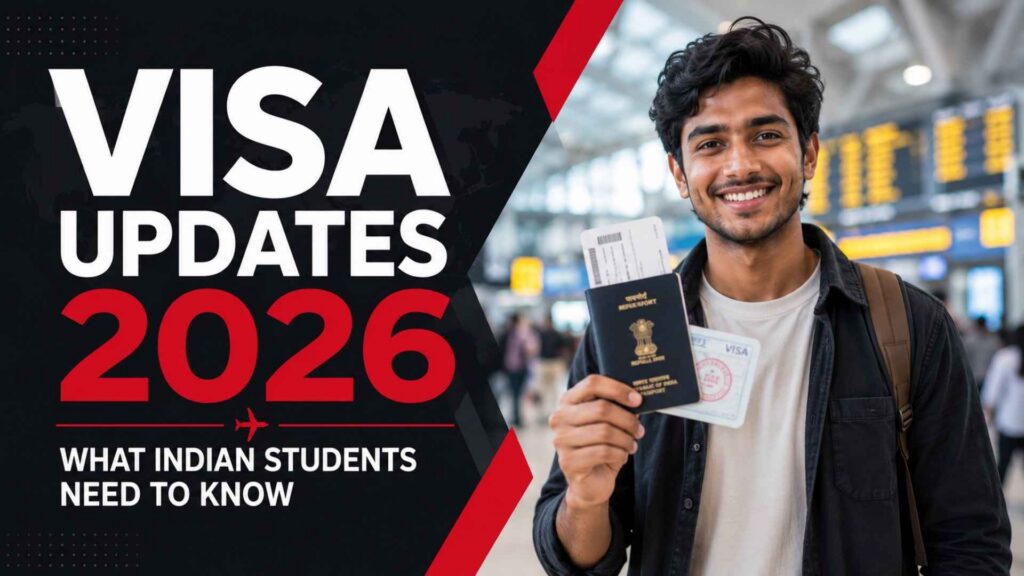
Latest International Visa Updates 2026 are important for Indian students planning to study abroad this year. If you’re an Indian student planning to study abroad in 2026, there’s one thing you absolutely cannot afford to ignore — visa updates. The international student visa landscape has shifted considerably over the past year, and what worked in 2023 or 2024 may not be enough today.
From tighter financial proof requirements and stricter documentation checks to caps on study permits and changes to post-study work visas, countries around the world are rewriting the rules. The good news? If you’re a genuine student with the right preparation, the doors are still wide open. You just need to know where to knock — and how.
This guide — brought to you by the team at Peoples Overseas — breaks down the latest student visa updates in 2026, country by country, with practical tips to help you apply with confidence.
Why Countries Are Tightening Student Visa Rules in 2026
It’s not just you noticing the change. Student visa rules across the board have become stricter, and there are real reasons behind it.
- Immigration control: Several popular destinations have faced political pressure to reduce overall migration numbers, and international students are part of that conversation.
- Fraud prevention: Fake enrollment, ghost students, and misuse of student visas for work purposes have pushed governments to increase verification.
- Surging application numbers: Record numbers of Indian students applying abroad has made embassies more cautious and selective.
- Housing and employment pressure: Countries like the UK, Canada, and Australia have faced public debate over housing shortages and job competition, directly influencing student visa policies.
Understanding why rules are changing helps you prepare how to respond to them smartly.
Latest Student Visa Updates Country-Wise (2026)
Latest International Visa Updates 2026 for USA 🇺🇸
The United States remains one of the top destinations for Indian students, but the F-1 visa process has become more scrutinised.
- Social media checks: Social media verification is now a standard part of the application review process. Your online presence may be checked.
- Financial proof requirements have increased — you need to demonstrate funds not just for the first year, but increasingly for the full program duration.
- Visa interview slots are in high demand; book early (3–4 months before your intended start date).
- OPT and STEM OPT extensions remain available, giving STEM graduates up to 3 years of post-study work authorization — one of the strongest post-study work visa options globally.
- Visa rejection rates in 2026 have edged upward for applicants with weak financial documentation or unclear academic intent.
Visit the official USA visa website for updates: US Travel Docs India
Latest International Visa Updates 2026 for Canada 🇨🇦
Canada introduced significant study permit caps starting in 2024, and those restrictions continue in 2026.
- The government has capped the number of new study permits issued annually. Provincial allocations mean some provinces are more accessible than others.
- Financial proof has been raised substantially — students must show CAD 20,635+ in available funds (beyond tuition), up from previous thresholds.
- Post-Graduation Work Permit (PGWP) eligibility has been tightened. Not all programs qualify, and the link to future PR pathways has been weakened for some streams.
- Processing times have improved slightly but can still range from 8–16 weeks depending on the visa office.
Check official Canada study permit updates here: IRCC Canada
Latest International Visa Updates 2026 for UK 🇬🇧
The UK has made several notable student visa rule changes in recent years, and 2026 continues that trend.
- The Graduate Route (post-study work visa allowing 2 years in the UK after graduation) remains in place but has been under political scrutiny.
- Dependent visa restrictions introduced in 2024 — limiting the ability of most international students to bring family members — remain in effect.
- English language requirements have been reinforced, with stricter checks on approved test scores.
- Financial requirements: students must show funds for the first year of tuition plus £1,334/month for living expenses in London.
- Processing time is typically 3 weeks for applications made outside the UK.
Latest International Visa Updates 2026 for Australia 🇦🇺
Australia has introduced its Genuine Student (GS) requirement — replacing the older Genuine Temporary Entrant (GTE) framework — and it is changing how applications are assessed.
- The GS requirement means you must demonstrate a clear, credible reason for choosing your specific course and institution in Australia.
- Financial proof requirements remain substantial, with proof of funds for tuition and living costs required upfront.
- Work rights for student visa holders remain capped at 48 hours per fortnight during study periods.
- The Temporary Graduate Visa (subclass 485) allows post-study work, but age limits and regional study incentives now influence how long you can stay.
Latest International Visa Updates 2026 for Germany 🇩🇪
Germany is emerging as one of the most favourable destinations for Indian students in 2026, and for good reason.
- Most public universities charge zero to minimal tuition fees, making the financial barrier much lower.
- Germany has been actively welcoming skilled international students, especially in STEM, engineering, and technology fields.
- The Opportunity Card (Chancenkarte) scheme allows qualified individuals to enter Germany to job search — a significant draw for post-graduation plans.
- Blocked account requirement: students need to show approximately €11,208/year in a blocked German bank account.
- Processing time: 4–12 weeks; applying well in advance is essential.
- Many master's programs are fully in English, making Germany far more accessible.
Germany is genuinely becoming easier for prepared, genuine students — one of the few bright spots in an otherwise tightening global landscape.
Latest International Visa Updates 2026 for New Zealand 🇳🇿
New Zealand offers a quieter but increasingly attractive alternative for Indian students.
- Post-study work visas are available for up to 3 years for graduates from eligible programs.
- New Zealand has maintained relatively straightforward student visa rules compared to other English-speaking countries.
- Financial requirements and English proficiency proof remain standard but manageable.
- The country is actively promoting itself to Indian students as applications from India have grown year on year.
Best Countries with Easier Student Visa Approval in 2026
If you’re looking for destinations with higher visa approval rates and a welcoming environment for Indian students, consider the following options:
| Country | Why It Works in 2026 |
|---|---|
| Germany | Low tuition, strong STEM demand, improving PR pathways |
| Ireland | English-speaking, EU access, growing tech sector |
| New Zealand | Stable policies, generous post-study work rights |
| Netherlands | Many English programs, student-friendly culture |
| France | Affordable living, Campus France support system |
Europe overall is emerging as a serious alternative to the traditional English-speaking destinations, especially for students willing to adapt.

Important Tips to Avoid Student Visa Rejection in 2026
Getting your visa rejected is not just a setback — it can delay your plans by a full year. Here is how to make your application bulletproof:
- Write a strong, genuine SOP (Statement of Purpose). Clearly explain why you chose this specific course, institution, and country. Avoid generic templates.
- Submit authentic financial documents. Sudden large deposits raise red flags. Your financial history should reflect genuine savings or sponsorship.
- Choose the right course wisely. Pick a program aligned with your academic background. A disconnect between your past education and chosen course is a common rejection trigger.
- Avoid unverified agents. Always verify the credentials of any education consultant you work with. Fraudulent agents have caused irreversible damage to many students' visa histories. At Peoples Overseas, every student's application is handled with complete transparency — no shortcuts, no false promises.
- Prepare for interviews. For countries requiring interviews (especially the USA), practise answering questions about your course, career goals, and reasons for choosing that country.
- Apply early. Most countries are experiencing higher processing volumes in 2026 — give yourself buffer time.
- Keep communication consistent. Everything in your SOP, financial documents, and interview answers should tell the same coherent story.
Future Trends in International Student Visas
Looking beyond 2026, here is where international student visas are headed:
- Digital and e-Visas: More countries are moving toward fully digital application systems, reducing paperwork but increasing digital verification.
- AI-based application screening: Governments are using automated tools to detect inconsistencies in applications — making authenticity more important than ever.
- Greater financial scrutiny: Expect financial proof requirements to keep climbing as housing costs rise globally.
- Skill-based migration pathways: Countries are increasingly designing student visa routes as feeder pipelines into skilled migration — especially in STEM, healthcare, and engineering.
- STEM preference: Universities and governments alike are offering incentives — longer post-study work rights, scholarships, faster PR pathways — for students in STEM disciplines.
The message is clear: be genuine, be skilled, and be prepared.
Conclusion
Yes, visa rules are stricter. Yes, rejection rates are rising in some countries. But here is what has not changed: genuine, well-prepared Indian students are still getting their visas, reaching their dream universities, and building successful international careers every single year.
The students who struggle are usually the ones who relied on shortcuts, fake documents, or poorly drafted applications. The ones who succeed are the ones who treated their visa application with the same seriousness as their university application.
Stay informed, plan early, and always work with verified information. The world is still very much open for Indian students who bring authenticity, ambition, and the right paperwork. If you need guidance at any step of the way, the Peoples Overseas team is here to help you navigate it — the right way.
Frequently Asked Questions (FAQs)
Which country is easiest for Indian students to get a visa in 2026?
Germany and New Zealand currently have among the more straightforward visa processes for Indian students. Germany’s public university system and the structured blocked account requirement make it transparent and manageable for genuine applicants.
Has Canada reduced student visas in 2026?
Yes. Canada has maintained study permit caps introduced in 2024. The number of new permits is limited annually, and financial proof requirements have also increased significantly.
Is Australia rejecting more Indian student visas?
Australia has introduced the Genuine Student (GS) requirement, which means more applications are being scrutinised for credibility. Students choosing institutions without a clear academic rationale are more likely to face rejection.
What are the new UK student visa rules in 2026?
The UK continues to restrict dependent visas for most international students. Financial requirements have increased, and the Graduate Route (post-study work) remains under policy review.
Which country gives the best post-study work visa?
The USA’s STEM OPT (up to 3 years), New Zealand (up to 3 years), and Germany’s Opportunity Card make these three strong contenders for the best post-study work options in 2026.
Why are student visa rejection rates increasing?
The main reasons include stricter fraud prevention measures, higher financial scrutiny, social media checks (USA), and inconsistencies between application documents and actual student intent.
Is Germany a good option for Indian students in 2026?
Absolutely. Germany offers low or no tuition fees, a growing English-taught programme catalogue, and strong demand for STEM graduates. It is one of the most accessible and rewarding destinations for Indian students right now.
What financial proof is needed for a USA student visa?
For the F-1 visa, you typically need to demonstrate funds covering at least the first year of tuition and living expenses, with evidence of ongoing financial support. Requirements vary by institution and programme.
Can I work while studying abroad in 2026?
Work rights vary by country. Canada and Australia allow part-time work with restrictions. The UK permits up to 20 hours per week during term. Germany allows 120 full days or 240 half days per year.
How early should I apply for a student visa?
Ideally, begin your visa application process at least 3–4 months before your intended course start date. Some countries, especially the USA, have high interview slot demand, so earlier is always better.
Navigate Visa Changes with Confidence
Don’t let changing rules derail your study abroad dreams. Connect with Peoples Overseas today for expert, transparent guidance tailored to the 2026 landscape.